
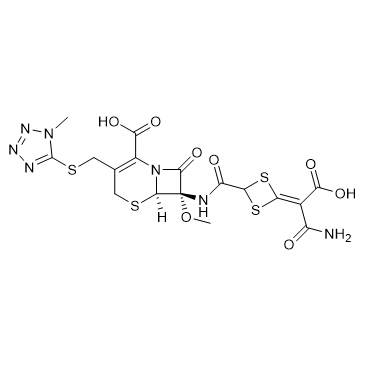
Cefotetan
CAS No. : 69712-56-7
| Size | Price | Stock |
|---|---|---|
| 5mg | $50 | In-stock |
| 10mg | $75 | In-stock |
| 25mg | $115 | In-stock |
| 50mg | $170 | In-stock |
| 100mg | $225 | In-stock |
| 200mg | $340 | In-stock |
| 500mg | $675 | In-stock |
| 1 g | Get quote | |
| 5 g | Get quote | |
| We match the lowest price on market. | ||
We offer a substantial discount on larger orders, please inquire via [email protected]
or Fax: (86)21-58955996
Inquiry for price and availability only. Please place your order via our email or fax.
| Cat. No. : | HY-N6670 |
| M.Wt: | 575.62 |
| Formula: | C17H17N7O8S4 |
| Purity: | >98 % |
| Solubility: | DMSO : 250 mg/mL (ultrasonic) |
Cefotetan is a binding agent that targets human Raf1 kinase inhibitor protein (hRKIP). Cefotetan binds to hRKIP, reduces the binding space between hRKIP and Raf1 kinase, relieves hRKIP's inhibition of the Ras/Raf1/MEK/ERK signaling pathway, and enhances ERK phosphorylation. Cefotetan can be used to study diseases associated with dysregulated Ras/Raf1/MEK/ERK signaling pathways. Cefotetan is also a broad-spectrum antibacterial agent that disrupts cell wall synthesis by binding to bacterial penicillin-binding proteins (PBPs). It is used to study bacterial infections such as bone, skin, urinary tract, and lower respiratory tract[1][2][3].
In Vitro:Cefotetan (20-80 μM; 30 min) significantly increases HEK293T and HeLa cells ERK phosphorylation levels, and this effect is more pronounced in cells overexpressing hRKIP[1].
Cefotetan is active against both Gram-positive bacteria (such as Staphylococci and Streptococci) and Gram-negative bacteria (such as Enterobacter and Haemophilus influenzae), and is highly stable against plasmid- and chromosome-mediated β-lactamases. 0.5 mg/L Cefotetan inhibits 75% of Enterobacter, 4 mg/L Cefotetan inhibits 90% of Enterobacter, and the MIC of Cefotetan against Neisseria gonorrhoeae is 0.06-2 mg/L[2].
In Vivo:Cefotetan (20, 50, 100 mg/kg; i.v.; single dose) shows that plasma drug concentrations increased with dose in animal models such as mice, rats, dogs and monkeys, with the highest concentration in the kidneys. The urinary excretion rate is 50%-74%, and the biliary excretion rate in rats could reach 48%[3].
Lorem ipsum dolor sit amet, consectetur adipisicing elit. Autem earum hic iste maiores, nam neque rem suscipit. Adipisci consequatur error exercitationem fugit ipsam optio qui, quibusdam repellendus sed vero! Debitis.
Inquiry Information- Product Name:
- Cefotetan
- Cat. No.:
- HY-N6670
- Quantity:
Your information is safe with us.