
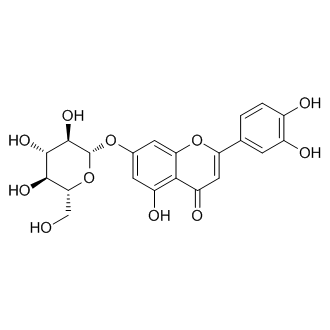
Cynaroside
CAS No. : 5373-11-5
(Synonyms: Luteolin 7-glucoside; Luteolin 7-O-β-D-glucoside)
| Size | Price | Stock |
|---|---|---|
| 25mg | $104 | In-stock |
| 100mg | $359 | In-stock |
| 200 mg | Get quote | |
| 500 mg | Get quote | |
| We match the lowest price on market. | ||
We offer a substantial discount on larger orders, please inquire via [email protected]
or Fax: (86)21-58955996
Inquiry for price and availability only. Please place your order via our email or fax.
| Cat. No. : | HY-N0540 |
| M.Wt: | 448.38 |
| Formula: | C21H20O11 |
| Purity: | >98 % |
| Solubility: | DMSO : 83.33 mg/mL (ultrasonic) |
Cynaroside (Luteolin 7-glucoside) is a flavonoid compound that exhibits anti-oxidative capabilities. Cynaroside is also a potent influenza RNA-dependent RNA polymerase inhibitor with an IC50 of 32 nM. Cynaroside also is a promising inhibitor for H2O2-induced apoptosis, has cytoprotection against oxidative stress-induced cardiovascular diseases. Cynaroside also has antibacterial, antifungal and anticancer activities, antioxidant and anti-inflammatory activities[1][3][4][5].
IC50 & Target:IC50:32 nM (RNA polymerase inhibitor)[2]
In Vitro: Cynaroside promots macrophage phenotypic transition from pro-inflammatory M1 to anti-inflammatory M2, and mitigates sepsis-associated liver inflammatory damage.
Cynaroside reduces binding of PKM2 to hypoxia-inducible factor-1α (HIF-1α) by abolishing translocation of PKM2 to the nucleus and promoting PKM2 tetramer formation, as well as suppressing phosphorylation of PKM2 at Y105 in vivo and in vitro.
Cynaroside restores pyruvate kinase activity, inhibits glycolysis-related proteins including PFKFB3, HK2 and HIF-1α, and inhibits glycolysisrelated hyperacetylation of HMGB1 in septic liver.
Cynaroside protects H9c2 cells against H2O2-induced apoptosis by decreasing ROS generation and inhibiting caspase activation in both the mitochondrial and death receptor pathways.
Cynaroside maintains mitochondrial function by regulating Bcl-2 protein expression, as well as JNK and P53 expression[2][3].
In Vivo: Cynaroside (i.p.; 5 mg/kg) reduces binding of PKM2 to hypoxia-inducible factor-1α (HIF-1α) by abolishing translocation of PKM2 to the nucleus and promoting PKM2 tetramer formation, as well as suppressing phosphorylation of PKM2 at Y105[2].
Lorem ipsum dolor sit amet, consectetur adipisicing elit. Autem earum hic iste maiores, nam neque rem suscipit. Adipisci consequatur error exercitationem fugit ipsam optio qui, quibusdam repellendus sed vero! Debitis.
Inquiry Information- Product Name:
- Cynaroside
- Cat. No.:
- HY-N0540
- Quantity:
Your information is safe with us.