| Size | Price | Stock |
|---|---|---|
| 1g | $11 | In-stock |
| 5g | $35 | In-stock |
| 10g | $43 | In-stock |
| 25g | $84 | In-stock |
| 100g | $335 | In-stock |
| 200 g | Get quote | |
| 500 g | Get quote | |
| We match the lowest price on market. | ||
We offer a substantial discount on larger orders, please inquire via [email protected]
or Fax: (86)21-58955996
Inquiry for price and availability only. Please place your order via our email or fax.
| Cat. No. : | HY-42034 |
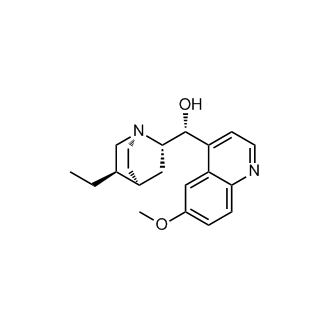
| M.Wt: | 326.44 |
| Formula: | C20H26N2O2 |
| Purity: | >98 % |
| Solubility: | H2O : < 0.1 mg/mL;DMSO : 100 mg/mL (ultrasonic) |
Hydroquinine (Dihydroquinine) is an anti-bacterial agent that inhibits both Gram-positive and Gram-negative bacteria. Hydroquinine inhibits the growth of multidrug-resistant pseudomonas aeruginosa via the suppression of the arginine deiminase pathway genes. Hydroquinine inhibits Plasmodium falciparum and Plasmodium berghei. Hydroquinine displays anti-malarial and demelanizing activities. Hydroquinine effectively induces specific RND-type efflux pump systems in Pseudomonas aeruginosa, particularly the MexCD-OprJ and MexXY efflux pumps. Hydroquinine inhibits Pseudomonas aeruginosa adhesion and biofilm formation. Hydroquinine serves as a precursor for derivatives such as C9 epihydroquinine, 9-acetoxy-10,11-dihydroquinine, and 10,11-dihydroquinine monohydrochloride[1][2][3].
In Vitro:Hydroquinine (0.25-10 mg/mL, 16-20 h) inhibits and kills gram-positive and gram-negative bacteria (PA-27853, PA-S1, PA-S2, PA-S3, PA-S4, PA-S5, PA-S6, S. aureus ATCC25923, S. aureus ATCC29213, E. cloacae ATCC2341, E. coli ATCC2452, E. coli ATCC25922, K. pneumoniae ATCC1705, P. aeruginosa ATCC BAA-2108 and P. aeruginosa ATCC27853) at minimum inhibitory concentration (MIC) and minimum bactericidal concentration (MBC) values of 1.25 and 5.00 mg/mL, respectively[1][2].
Hydroquinine (16-20 h) shows notable partial synergistic effects with Ceftazidime (HY-B0593) (fractional inhibitory concentration index (∑FICI) of 0.750 and 0.625 against clinical MDR P. aeruginosa strains PA-S4 and PA-S5, respectively)[1].
Hydroquinine (1.25-1.5 mg/mL, 1 h) inhibits P. aeruginosa growth through decreased expression of ADI-pathway related genes and decreased expression levels of adhesion-related genes[1][3].
Hydroquinine (0.625-5 mg/mL, 0-8 h) kills P. aeruginosa ATCC27853 and ATCC BAA-2108, achieving 20-40% killing at 0.5 × MIC, approximately 50% at MIC, and 90% at MBC after 4 hours[2].
Hydroquinine (1.25 mg/mL, 1 h) significantly upregulates RND-type efflux pump genes in P. aeruginosa ATCC27853[2].
Hydroquinine (1.25-2.5 mg/mL, 6-24 h) exhibits inhibitory activity comparable to multipurpose solutions (MPSs) and, in combination, damages cell structure while demonstrating anti-adhesion efficacy[3].
Hydroquinine (0-50 µM, 24-72 h) inhibits Toxoplasma gondii RH-RFP tachyzoite growth, with IC50 values of 0.63, 0.68, and 0.0014 µM after 24, 48, and 72 hours, respectively[4].
Hydroquinine (6.25-50 µM) inhibits tachyzoite infection and replication in a dose-dependent manner, reducing parasitophorous vacuole (PV) formation at 6.25 µM and further decreasing tachyzoite replication at 50 µM[4].
Hydroquinine (6.25-50 µM, 105 min) induces reactive oxygen species generation in Toxoplasma gondii[4].
Hydroquinine (6.25-50 µM, 8 h) causes mitochondrial membrane damage in Toxoplasma gondii but not of the host cells[4].
Lorem ipsum dolor sit amet, consectetur adipisicing elit. Autem earum hic iste maiores, nam neque rem suscipit. Adipisci consequatur error exercitationem fugit ipsam optio qui, quibusdam repellendus sed vero! Debitis.
Inquiry Information
Your information is safe with us.