
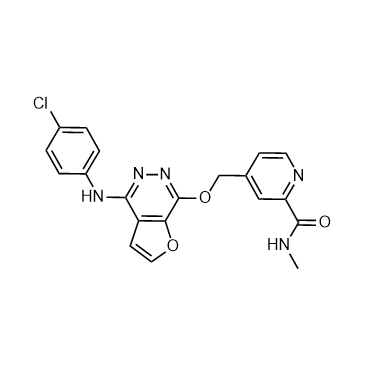
Telatinib
CAS No. : 332012-40-5
(Synonyms: Bay 57-9352)
| Size | Price | Stock |
|---|---|---|
| 5mg | $50 | In-stock |
| 10mg | $70 | In-stock |
| 25mg | $150 | In-stock |
| 50mg | $250 | In-stock |
| 100mg | $450 | In-stock |
| 200 mg | Get quote | |
| 500 mg | Get quote | |
| We match the lowest price on market. | ||
We offer a substantial discount on larger orders, please inquire via [email protected]
or Fax: (86)21-58955996
Inquiry for price and availability only. Please place your order via our email or fax.
| Cat. No. : | HY-10527 |
| M.Wt: | 409.83 |
| Formula: | C20H16ClN5O3 |
| Purity: | >98 % |
| Solubility: | DMSO : ≥ 46 mg/mL |
Telatinib (Bay 57-9352) is an orally active, small molecule inhibitor of VEGFR2, VEGFR3, PDGFα, and c-Kit with IC50s of 6, 4, 15 and 1 nM, respectively. IC50 & Target:IC50: 6 nM (VEGFR2), 4 nM (VEGFR3), 15 nM (PDGFα), 1 nM (c-Kit)[1] In Vitro:Telatinib has low affinity for the Raf kinase pathway, epidermal growth factor receptor family, the fibroblast growth factor receptor (FGFR) family, or the Tie-2 receptor[2]. Telatinib is metabolized by various cytochrome P450 (CYP) isoforms including CYP3A4/3A5, CYP2C8, CYP2C9, and CYP2C19 as well as by uridine diphosphate glucuronosyltransferase 1A4 (UGT1A4), with the formation of the N-glucuronides of telatinib as the major biotransformation pathway in man. In vitro studies show telatinib to be a weak substrate of the adenosine triphosphate binding cassette (ABC) B1 (ABCB1) transporter[3]. Telatinib at 1 μM significantly enhances the intracellular accumulation of [3H]-mitoxantrone (MX) in ABCG2-overexpressing cell lines. In addition, telatinib at 1 μM significantly reduces the rate of [3H]-MX efflux from ABCG2-overexpressing cells. Furthermore, telatinib significantly inhibits ABCG2-mediated transport of [3H]-E217βG in ABCG2 overexpressing membrane vesicles[4]. In Vivo:Telatinib causes a significant decrease in endothelium-dependent and endothelium-independent vasodilation. VEGF inhibition by itself decreases NO synthesis, which promotes vasoconstriction, increases peripheral resistance, and therefore can induce an increase in blood pressure[1]. Telatinib (15 mg/kg) with doxorubicin (1.8 mg/kg) significantly decreases the growth rate and tumor size of ABCG2 overexpressing tumors in a xenograft nude mouse model[4].
Lorem ipsum dolor sit amet, consectetur adipisicing elit. Autem earum hic iste maiores, nam neque rem suscipit. Adipisci consequatur error exercitationem fugit ipsam optio qui, quibusdam repellendus sed vero! Debitis.
Inquiry Information- Product Name:
- Telatinib
- Cat. No.:
- HY-10527
- Quantity:
Your information is safe with us.