
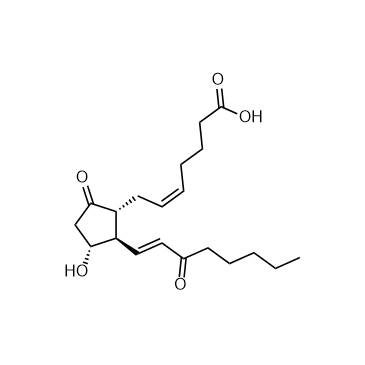
15-keto-Prostaglandin E2
CAS No. : 26441-05-4
(Synonyms: 15-keto-PGE2)
| Size | Price | Stock |
|---|---|---|
| 500μg | $151 | Get quote |
| 1mg | $265 | In-stock |
| 5 mg | Get quote | |
| 10 mg | Get quote | |
| We match the lowest price on market. | ||
We offer a substantial discount on larger orders, please inquire via [email protected]
or Fax: (86)21-58955996
Inquiry for price and availability only. Please place your order via our email or fax.
| Cat. No. : | HY-113205 |
| M.Wt: | 350.45 |
| Formula: | C20H30O5 |
| Purity: | >98 % |
| Solubility: | 10 mM in DMSO;10 mM in DMSO |
15-keto-Prostaglandin E2 (15-keto-PGE2) is an endogenous PGE2 metabolite. 15-keto-Prostaglandin E2 inhibits STAT3 activation by binding to the Cys259 residue of STAT3. 15-keto-Prostaglandin E2 binds to and stabilizes EP2 and EP4 receptors. 15-keto-Prostaglandin E2 inhibits the growth and progression of breast cancer cells. 15-keto-Prostaglandin E2 activates PPAR-γ and promotes fungal growth. 15-keto-Prostaglandin E2 disrupts glomerular vascularization during zebrafish development and reduces the surface area of the glomerular filtration barrier[1][2][3].
In Vitro:15-keto-PGE2 (1 μM; 20 min) binds to and stabilizes HiBiT-tagged hEP2 receptors on the cytoplasmic membrane of MMY28 yeast[1].
15-keto-PGE2 (10-20 μM; 24 h) dose-dependently inhibits the clonogenic capacity of MDA-MB-231 cells[3].
In Vivo:15-keto-Prostaglandin E2 (500 μM; immersion) impairs pronephric development and glomerular filtration barrier formation in zebrafish via the EP2/EP4 receptor signaling pathway, resulting in pronephric abnormalities combined with yolk sac edema in embryos, late insertion defects in glomeruli, and a significant reduction in glomerular surface area[1].
15-keto-Prostaglandin E2 (10 μM; immersion) significantly increases the fungal load of Cryptococcus neoformans Δplb1-GFP in zebrafish larvae, reaching 1.56 times that of the control group[2].
15-keto-Prostaglandin E2 (70-140 μg/kg; subcutaneous injection; administered daily for 4 consecutive weeks) dose-dependently inhibits the growth of MDA-MB-231 breast cancer xenografts in BALB/c nude mice[3].
Lorem ipsum dolor sit amet, consectetur adipisicing elit. Autem earum hic iste maiores, nam neque rem suscipit. Adipisci consequatur error exercitationem fugit ipsam optio qui, quibusdam repellendus sed vero! Debitis.
Inquiry Information- Product Name:
- 15-keto-Prostaglandin E2
- Cat. No.:
- HY-113205
- Quantity:
Your information is safe with us.