
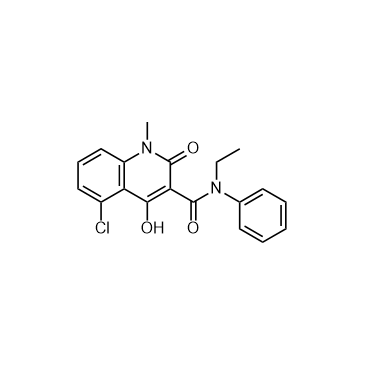
Laquinimod
CAS No. : 248281-84-7
(Synonyms: ABR-215062)
| Size | Price | Stock |
|---|---|---|
| 5mg | $55 | In-stock |
| 10mg | $77 | In-stock |
| 50mg | $132 | In-stock |
| 100mg | $198 | In-stock |
| 500mg | $495 | In-stock |
| 1 g | Get quote | |
| 5 g | Get quote | |
| We match the lowest price on market. | ||
We offer a substantial discount on larger orders, please inquire via [email protected]
or Fax: (86)21-58955996
Inquiry for price and availability only. Please place your order via our email or fax.
| Cat. No. : | HY-13010 |
| M.Wt: | 356.80 |
| Formula: | C19H17ClN2O3 |
| Purity: | >98 % |
| Solubility: | DMSO : 25 mg/mL (ultrasonic;warming;heat to 60°C) |
Laquinimod (ABR-215062), an orally available carboxamide derivative, is a potent immunomodulator which prevents neurodegeneration and inflammation in the central nervous system. Laquinimod reduces astrocytic NF-κB activation to protect from Cuprizone-induced demyelination. Laquinimod has?the?potential?for relapsing remitting (RR) and chronic progressive (CP) forms of multiple sclerosis (MS; RRMS or CPMS) as well as neurodegenerative diseases?research[1][2][3][4]. IC50 & Target: NF-κB[3] In Vitro: Laquinimod reverses EAE and inhibits pathogenic T cell immune responses. Laquinimod reverses RR-EAE and inhibits inflammatory T cell responses via a direct effect on myeloid APC. Laquinimod alters myeloid APC subsets and inhibits Th1 and Th17 polarization of myelin-specific T cells. Laquinimod-induced type II (M2) monocytes reverse established EAE[1]. Laquinimod modulates the phenotype of B cells of healthy donors. Laquinimod modulates expression of markers related to regulatory capacity in B cells of RRMS patients. Laquinimod reduces IFNγ cytokine expression in CD4+ T cells[2]. In Vivo: Laquinimod treatment inhibits donor myelin-specific T cells from transferring EAE to naive recipient mice. In vivo laquinimod treatment alters subpopulations of myeloid antigen presenting cells (APC) that include a decrease in CD11c+CD11b+CD4+?dendritic cells (DC) and an elevation of CD11bhiGr1hi monocytes[1].
Lorem ipsum dolor sit amet, consectetur adipisicing elit. Autem earum hic iste maiores, nam neque rem suscipit. Adipisci consequatur error exercitationem fugit ipsam optio qui, quibusdam repellendus sed vero! Debitis.
Inquiry Information- Product Name:
- Laquinimod
- Cat. No.:
- HY-13010
- Quantity:
Your information is safe with us.