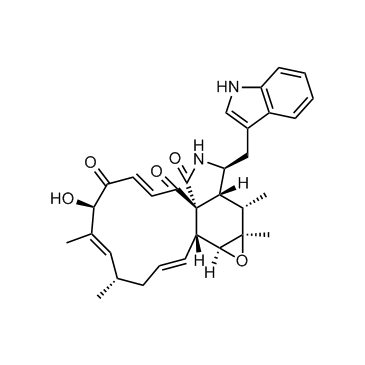
Chaetoglobosin A


CAS No. : 50335-03-0

50335-03-0
Price and Availability of CAS No. : 50335-03-0
Size Price Stock
1mg $170 In-stock
5 mg Get quote
10 mg Get quote
We match the lowest price on market.

We offer a substantial discount on larger orders, please inquire via [email protected]

or Fax: (86)21-58955996

Inquiry for price and availability only. Please place your order via our email or fax.

Cat. No. : HY-N6744
M.Wt: 528.64
Formula: C32H36N2O5
Purity: >98 %
Solubility: 10 mM in DMSO;DMSO : ≥ 10mg/mL
Introduction of 50335-03-0 :

Chaetoglobosin A is a secondary metabolite and nematicide. Chaetoglobosin A is produced by Penicillium aquamarinium. Chaetoglobosin A targets Filamentous actin in cells, thereby inducing cell cycle arrest, and inhibiting membrane ruffle formation and cell migration. Chaetoglobosin A preferentially induces Apoptosis in chronic lymphocytic leukemia cells. Chaetoglobosin A induces dose- and time-dependent death in J2 larvae of the southern root-knot nematode (Meloidogyne incognita). Chaetoglobosin A can be used in studies related to root-knot nematode disease and chronic lymphocytic leukemia[1][2]. IC50 & Target:Filamentous actin[1] In Vitro:Chaetoglobosin A (3-300 μg/mL; 3-14 days) inhibits egg hatching of Meloidogyne incognita; after 14 days of exposure, the hatching inhibition rate reaches 63.7% at the concentration of 30 μg/mL[1].
Chaetoglobosin A (3-300 μg/mL; 24-72 h) induces dose- and time-dependent death in J2 larvae of Meloidogyne incognita, with an LC50 of 77.0 μg/mL after 72 h of exposure[1].
Chaetoglobosin A (1-10 μM; 24-48 h) preferentially reduces the viability of primary chronic lymphocytic leukemia (CLL) cells (median LD50 = 2.8 μM) and induces caspase-dependent apoptosis, with minimal effects on normal B cells or T cells, compared to PBMCs from healthy donors and non-malignant stromal/fibroblast cells[2].
Chaetoglobosin A (1 μM) inhibits SDF1α-induced migration of primary CLL cells at a concentration of 1 μM[2]. In Vivo:Chaetoglobosin A targets lymphocytes and highly proliferating cells in vivo, inducing spleen and thymus necrosis and spermatocyte degeneration in mice and rats[2].

Your information is safe with us.