
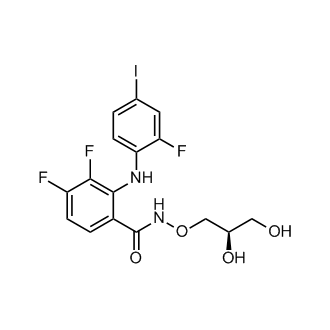
Mirdametinib
CAS No. : 391210-10-9
(Synonyms: PD0325901; PD325901)
| Size | Price | Stock |
|---|---|---|
| 5mg | $60 | In-stock |
| 10mg | $108 | In-stock |
| 25mg | $180 | In-stock |
| 50mg | $228 | In-stock |
| 100mg | $348 | In-stock |
| 200 mg | Get quote | |
| 500 mg | Get quote | |
| We match the lowest price on market. | ||
We offer a substantial discount on larger orders, please inquire via [email protected]
or Fax: (86)21-58955996
Inquiry for price and availability only. Please place your order via our email or fax.
| Cat. No. : | HY-10254 |
| M.Wt: | 482.19 |
| Formula: | C16H14F3IN2O4 |
| Purity: | >98 % |
| Solubility: | DMSO : ≥ 56 mg/mL |
Mirdametinib (PD0325901) is an orally active, selective and non-ATP-competitive MEK inhibitor with an IC50 of 0.33 nM. Mirdametinib exhibits a Kiapp of 1 nM against activated MEK1 and MEK2. Mirdametinib suppresses the expression of p-ERK1/2 and induces apoptosis. Mirdametinib has anti-cancer activity for a broad spectrum of human tumor xenografts[1][2][3].
In Vitro:Mirdametinib (PD325901; 0.0064, 0.032, 0.16, 0.8, 4, 20, 100 nM; for 2 days) inhibits the growth of Papillary thyroid carcinomas (PTC) cell lines (TPC-1 cells and K2 cells) with GC50 of 11 nM and 6.3 nM, respectively[3].
Mirdametinib (100 nmol/L; for 4 days) induces apoptosis in K2 cells (top) or TPC-1 cells[3].
Mirdametinib (0.1, 1, 10, 100, 1000 nM; for 1 hour) suppresses the expression of p-ERK1/2 in K2 cells (top) or TPC-1 cells[3].
Mirdametinib prevents the growth of melanoma cell lines. Mirdametinib significantly prevents the the growth of PTC cells harboring a BRAF mutation at very low concentration (10 nM)[3].
In Vivo:Mirdametinib (25 mg/kg, p.o.) inhibits phosphorylation of ERK by more than 50% at 24 hours post-dosing. Mirdametinib (25 mg/kg/day; po) produces a 70% incidence of complete tumor responses (C26 model)[2].
Mirdametinib (20-25 mg/kg/day; oral gavage; for 3 weeks (5 consecutive days/week)) suppresses tumor growth completely in mice inoculated with PTC cells carrying a BRAF mutation (K2) and significantly decreased tumor growth in mice inoculated with PTC cells carrying the RET/PTC1 rearrangement (TPC-1) in athymic Ncr-nu/nu mice at ages 6 to 8 weeks[3].
Lorem ipsum dolor sit amet, consectetur adipisicing elit. Autem earum hic iste maiores, nam neque rem suscipit. Adipisci consequatur error exercitationem fugit ipsam optio qui, quibusdam repellendus sed vero! Debitis.
Inquiry Information- Product Name:
- Mirdametinib
- Cat. No.:
- HY-10254
- Quantity:
Your information is safe with us.